The National Center for Complimentary and Integrative Health (NCCIH) conducts and supports research and provides information about complementary health products and practices in the context of whole person health. This National Institutes of Health (NIH) agency has been studying whether or not to add a spiritual domain to their Whole Person Health Model since 2022 when it held a public Request for Information to identify determinants of Whole Person Health.
The diagram below is what their model would look like if the spiritual domain was included. The diagram links to a post about this consideration written by the Director of NCCIH.

During the NCCIH Advisory Council Meeting on July 1, 2025 (video cast), a Working Group on Spiritual Health presented a Final Report on this issue to the Advisory Council. (That report begins at the 1:34:10 mark in the video. See screenshots of many of the slides at this link – NCCIH Spirituality and Health Working Group Report – 7 1 25.)
After almost two years of study, they reported that “Well designed research is needed to evaluate the role of spiritual health/wellbeing to justify its inclusion as a domain of whole person health.”
So, NCCIH still will not recognize that a spiritual domain belongs in its Whole Person Health Model.
This exclusion of the spiritual dimension not only impacts negatively on all aspects of personal wellbeing, but on the public health of our nation such as chronic diseases and deaths of despair and their related plaguing social issues such as poverty, homelessness, substance abuse, unemployment, crime, violence, and suicide.
It will also impact negatively on the funding of research in the field of spirituality and health.
In this post I will challenge some information that the Working Group presented and again make a case for the inclusion of a Spiritual domain to their model.
Justification to Include the Spiritual Domain to the NCCIH Whole Person Health Model
In 2022 I wrote a detailed ‘white paper’ type of post titled Spirituality and Health in the Federal Government. The concern I addressed is that spirituality as a component of health and wellbeing is not generally recognized by the health agencies of our U.S. government. I pointed out at that time that the NCCIH model of Whole Person Health did not include a spiritual domain. In 2023 I wrote another post specifically related to their Whole Person Health Model. In both instances, I sent communications to the Director of NCCIH urging her agency to implement the recommendations I made in the posts.
The information I am presenting below is new and additional justification for the inclusion of a Spiritual domain to the NCCIH Whole Person Health Model.
A. NIH Agencies Indicate that the Care of the Spirit is Important.
- A page of the NCCIH’s own website recognizes that a human’s spirit is a part of one’s whole person with the following text: “The word holistic (sometimes spelled wholistic) often refers to the treatment of the whole person—body, mind, emotions, and spirit – to achieve wellness and good health.” This recognition appeared on the NCCIH website well before they developed their model. So, some staff at NCCIH have previously recognized that the human spirit is part of the whole person!
- The National Cancer Institute (Another National Institute of Health agency) recognizes that there is a spiritual aspect of a person’s health. This statement is on their website: An Integrative medicine approach to medical care “often stresses the patient’s preferences, and it attempts to address the mental, physical, and spiritual aspects of health.” This NIH agency understands that there is a spiritual component to a person’s health.
B. U.S. Adults Say It’s Important
-
- In 2022, NCCIH held a Request For Information (RFI) to the public to identify a Set of Determinants for Whole Person Health. They asked the public to assist them in compiling a list of major determinants of health that encompass the full continuum of biological, behavioral, social, and environmental domains. Their instructions to respondents did not ask them to consider a spiritual domain. Results of the RFI were that 19% of respondents indicated that spirituality/religion was a determinant of health. This factor was the fourth most frequently identified determinant even though respondents were asked to consider only the biological, behavioral, social, and environmental domains of health. (A request for more complete data of the results of the RFI was made to NCCIH but denied.)
- The greatest majority of US adults recognize that there is a spiritual aspect to their being and that caring for it is an important aspect of health.
a. The Pew Research Center’s Religious Landscape Study of U.S. Adults conducted in 2023-2024 found the following pertinent data:
-
-
-
- 86% of American adults believe that humans have a soul or spirit in addition to their physical bodies.
- 83% of American adults believe in God or a universal spirit.
- 75% of American adults acknowledge having a sense of spiritual peace and wellbeing at some time during the year.
-
-
b. 75% of Americans attend to their vital spiritual needs by choosing to affiliate with a specific religion. 69% of this group identify as Christian. (Gallup 2021 Poll on Religion in America) This is relevant because people align with various religions, and engage in practices of those religions, to attend to their deep spiritual nature and needs. This is how they live out their spirituality.
c. A Mayo Clinic Proceedings publication reports that a survey found that 94% of patients regard their spiritual health and their physical health as equally important.
d. The same Mayo Clinic publication reports that another survey of family physicians found that 96% of patients believe spiritual well-being is an important factor in health.
e. Prayer is one of the most common spiritual practices by individuals in the United States, regardless of spiritual or religious orientation. A 2024 Pew Research Center report indicated that 45% of adults in the United States pray daily. Research on the impact of religion and spirituality (R/S) and health demonstrates that practices such as prayer generally impact favorably on wellbeing. Yet, prayer was removed as a form of complementary and alternative medicine (CAM) by NCCIH in the 2007 timeframe. Read this post – Prayer is Excluded as a Form of Complementary and Alternative Medicine by Our Federal Government.
In their early efforts to develop their framework for Whole Person Health, an NCCIH document includes the statement that the “individual person, including what matters to that individual and how the individual feels about their health, is central to the framework.”
Reliable polls indicate that people say that their spiritual wellbeing matters to them.
Since adults in the U.S. report that their spiritual wellbeing is an important facet of their health, NCCIH should recognize that a ‘patient-centered’ approach to caring for individuals should include the spiritual domain.
C. The Research on the Connection Between Spirituality/Religion and Health
The Working Group statement that “Well designed research is needed to evaluate the role of spiritual health/wellbeing to justify its inclusion as a domain of whole person health” is unmerited.
The spirituality/religion (S/R) and health research in the scientific literature has demonstrated a clear and strong relationship between many factors of S/R and well-being and health.
-
-
- A prominent researcher in the field, Harold Koenig, MD writes, “There is overwhelming, rigorous, objective evidence being published by some of the world’s top public health institutions that religious faith and practice influence mental, social, behavioral, and physical health (Koenig et al., 2024)” Koenig, H.G., VanderWeele, T.J., & Peteet, J.R. (2024). Handbook of Religion and Health, 3rd ed. NY, NY: Oxford University Press.
- In a related journal article this statement was written by 12 distinguished researchers in the field: “The growing body of robust, empirical research strongly links spiritual beliefs, states of being, communal practices, and private rituals to a range of beneficial health out- comes including lower all-cause mortality.” This was written in the 2024 Health Affairs journal article titled – Spirituality As A Determinant Of Health: Emerging Policies, Practices, And Systems, Long, K, et. al.
- In a study (published in a 2020 issue of JAMA Psychiatry) of 66,492 female registered nurses and 43,141 male health care professionals in the US, attendance at religious services at least once per week was associated with a 68% lower hazard of death from despair (deaths related to suicide, drug use, and alcohol poisoning) among women and a 33% lower hazard among men compared with never attendance.
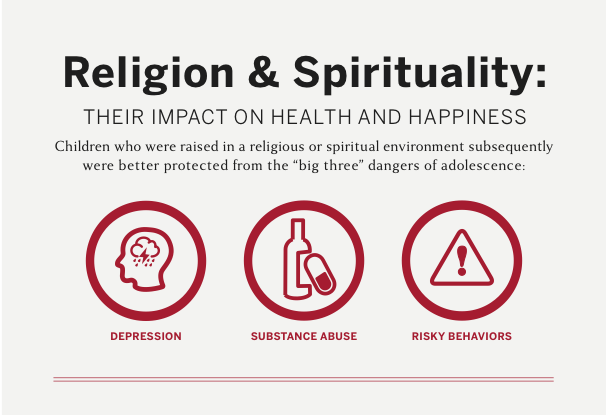
- “Participating in spiritual practices during childhood and adolescence may be a protective factor for a range of health and well-being outcomes in early adulthood, according to a study from Harvard T.H. Chan School of Public Health, published in the September 13, 2018 issue of the American Journal of Epidemiology.
- 5. See paragraph 8 in this blog post – Spirituality and Health in Our Federal Government – for a more detailed listing of the scientific research in this area.
-
D. The Spiritual Dimension of Wellbeing is Recognized by Leading Institutions
The NCCIH Working Group Report includes a statement as follows: ‘Spiritual Health/Well-being is currently not routinely incorporated as a separate factor of whole person health.’ This statement is not valid as evidenced by the following:
-
-
- The organizations listed below promote the inclusion of a spiritual domain to their Whole Person Health initiatives/models, or to the spiritual dimension as part of ‘whole person’ care:
- National Institute for Whole Health
- George Washington University Wellness Model
- The George Washington University Institute for Spirituality and Health (GWish)
- Georgetown University
- Harvard University’s Initiative on Health, Religion, and Spirituality
- University of Michigan Medical School’s Program on Health, Spirituality and Religion – (a LINK to their model)
- Veterans Health Administration
- Department of Defense – Total Force Fitness
- US Army – Holistic Health and Fitness
- Academy of Integrative Health & Medicine (AIHM)
- American Holistic Nurses Association
- National Wellness Institute
- Substance Abuse and Mental Health Services Administration (SAMHSA)(an agency within the U.S. Department of Health and Human Services)
- Southern California University of Health Sciences
- University of Maryland
- University of California Davis
- Yale Program For Medicine, Spirituality and Religion
- University of New Hampshire
- University of Miami Miller School of Medicine
- Columbia University’s Spirituality Mind Body Institute
- Duke University Wheel of Health
- Duke University Center for Spirituality, Theology and Health
- Rocky Mountain University of Health Professions
- National Cancer Institute (A National Institute of Health Agency) This statement is on their website: An Integrative medicine approach to medical care “often stresses the patient’s preferences, and it attempts to address the mental, physical, and spiritual aspects of health.”
- The American Medical Association recognizes the importance of individual patient spirituality and its impact on health and encourages patient access to spiritual care services.
-
2. In a 2023 article published in the International Journal of Wellbeing, Assessing the Structures and Domains of Wellness Models: A Systematic Review, the authors write – “Based on this review the most commonly occurring domains of wellness are related to “Physical”, “Psychological”, “Social”, “Emotional”, “Spiritual”, and “Environmental” themes.”
3. In another article published on March 7, 2025 in the International Journal of Women’s Health, The Evolution of Wellness Models: Implications for Women’s Health and Well-Being, the authors identified 12 Wellness/Holistic/Whole Person Health models. Spiritual Wellness was included in the majority (7) of those models and the authors write, “Spiritual wellness was a notable dimension in several models, including the Wheel of Wellness, Perceived Wellness, and Whole-Person Wellness, reflecting its importance in a holistic view of wellness.”
The above references support the fact that Spiritual Health/Well-being is currently routinely incorporated as a separate factor of whole person health.
E. Spiritual Health Should be Included in the Measurement of Whole Person Health
Authors of recent peer-reviewed journal articles do recommend the inclusion of the spiritual dimension when measuring whole person health.
-
-
- In a 2025 peer-reviewed journal article titled Measuring Whole Person Health: A Scoping Review – the authors write the following in their results section: “Our search identified six WPH (Whole Person Health) measures. All six WPH measures included assessments of the biological/physical, behavioral/mental, social, and spiritual domains.” This was their conclusion: “The results of this scoping review provide a greater understanding of the domains involved in WPH as a multidimensional construct. Although no existing WPH measures are suitable for broad use, their structural commonalities imply that WPH measure development efforts should consider the assessment of physical, mental, social, spiritual (my emphasis), and individual domains.” Measuring Whole Person Health: A Scoping Review. Journal of Alternative and Complementary Medicine, April 3, 2025 (This very recent research was funded by NCCIH.)
- In the book, Measuring Well-Being there is a chapter titled Tradition-Specific Measures of Spiritual Well-Being, authored by Tyler J. VanderWeele, Katelyn N. G. Long, and Michael J. Balboni of Harvard University. They write – “The neglect of spiritual well-being is thus an important omission in most assessments of well-being,” and also, “Since it is indeed the case that so much of the world’s population views religion and spiritual well-being as central, it would seem that any holistic assessment of well-being would arguably allow space for assessments of spiritual well-being as well.”
-
F. Spirituality is Recognized as a Determinant of Health
As part of their rationale for not including spirituality as a domain of whole person health, the Working Group reported that Social and Environmental factors are accepted as ‘determinants of health.’ They imply that spiritual factors are not accepted or recognized as a determinant of health.
-
-
- 12 leading researchers in the field of spirituality and health do recognize that spirituality is a determinant of health as pointed out in this June, 2024 Health Affairs journal article – Spirituality As A Determinant Of Health: Emerging Policies, Practices, And Systems. In the article they state, “Reimagining public health’s future should include explicitly considering spirituality as a social determinant of health that is linked to human goods and is deeply valued by people and their communities.” They also state, “As empirical scholarship increasingly illuminates these connections, public health systems must seek additional ways to recognize spiritual determinants of health as a vital dimension, and extension, of whole person, whole-community well-being.” These recommendations emerged from their systematic review of empirical evidence on spirituality, serious illness, and population health published between 2000 and 2022.
- In a 2023 council meeting, the NIH’s National Institute on Minority Health and Health Disparities approved “spirituality and religiosity as psychosocial determinants of health” as a research concept.
- In paragraph B 1 above, read that in a public request for information, spirituality was the fourth ranked determinant of health identified by respondents.
-
Spiritual and religious factors are recognized by leading health officials, and by the public, as a determinant of health.
G. Sacred Texts Recognize That Humans Have a Spirit
Sacred texts of the major religions of the United States inform us that we are spiritual beings and also provide instructions on caring for one’s spirit. The following are a few examples:
- Genesis 2:7 of the Jewish Torah describes God breathing “the breath of life” into man, making him a “living soul.” In Hebrew, the word for breath, neshamah, is also used for “spirit,” which annotates its divine origin and importance.
- In The Holy Bible, our Creator, God, provides instructions and encouragement for living a full life according to his design. In the book of 1st Thessalonians, Paul writes the following: “Now may the God of peace make you holy in every way, and may your whole spirit and soul and body be kept blameless until our Lord Jesus Christ comes again.” (1 Thess 5:23) This text provides us insight into the holistic nature of a person.
- “Spend your time and energy in training yourself for spiritual fitness. Physical exercise has some value, but spiritual exercise is much more important for it promises a reward in both this life and the next. This is true and everyone should accept it.” 1 Timothy 4:7-9 (New Living Translation – First Edition). This scripture in the Bible speaks to the significance of one’s spiritual wellbeing and its contribution to life.
The role of research should be to better understand how we are to care for our spiritual health and to learn more about the interaction between the spiritual, physical, emotional, and mental domains of wellbeing. Sacred texts inform us how to care the spiritual dimension and ought to be considered in the research on this topic.
Summary:
During the July 1, 2025 Council meeting referenced above, the NCCIH Director, Dr. Helene Langevin indicated that the NCCIH has been ‘dancing around’ this topic of spirituality for quite some time. They continue to ‘dance around’ this issue by not recognizing that there is a spiritual domain to one’s whole person health and by not adding this as a domain to their Whole Person Health Model.
NCCIH’s position is that more studies and research on the connection between spiritual well-being and health is still required to justify the inclusion of the spiritual domain in its model. At their current pace of studying this issue, it could likely be many more years before NCCIH might make a decision to recognize that spiritual well-being is a relevant and important facet of whole person health.
Spiritual distress and poor spiritual health are at the root of many chronic diseases and social issues. Delaying the addition of a spiritual domain to their model continues to contribute to the poor health and well-being of our country’s citizens. This negatively impacts many chronic diseases, deaths of despair, and related social issues such as poor mental health, poverty, homelessness, substance abuse, unemployment, crime, violence, and suicide.
Other federal agencies, including Health and Human Services agencies, are beginning to use the NCCIH model of whole person health for their policies, programs, educational materials and research. The continued use of the existing model, which excludes a spiritual domain, by other federal agencies further contributes to the poor health of our country’s citizens.
NCCIH has a robust 5 Year (2021-2025) Strategic Plan to guide their research. If the next version of this strategic plan were to be developed with a model of Whole Person Health that excludes the spiritual domain of health, it would further impact negatively on the public health of our country.
With the above in mind, I have provided compelling rationale for the NCCIH to recognize that spirituality is an important, seperate component of integrative health care, and for the immediate inclusion of the spiritual domain to the NCCIH whole person health model.
Recommendations:
-
-
- That members of the NCCIH Working Group on Spiritual Health review the contents of this post and reconsider their decision to not add a spiritual domain to the NCCIH Whole Person Health Model.
- That the members of National Advisory Council for Complementary and Integrative Health (NACCIH) review this post and recommend to the leadership of NCCIH that the Spiritual domain of individual health be added to its Whole Person Health Model.
- That the staff of NCCIH make a decision to add the Spiritual domain of individual health to its Whole Person Health Model.
- That in any future NCCIH workshop to explore spiritual health, people of faith representing the most prevalent religions in the U.S. be included.
- That NCCIH recognize prayer as a form of CAM and that it be added back to future National Health Interview Surveys related to complementary and alternative medicine. (Read this more complete blog post concerning this issue.)
- That each recommendation made in the paper – Spirituality As A Determinant Of Health: Emerging Policies, Practices, And Systems – be implemented.
- That the recommendations I made in an earlier post concerning Spirituality and the Federal Government be implemented as well.
- That further research in the field of spirituality/religion and health include the study of sacred texts to learn of principles and interventions related to spiritual wellbeing that have been provided to us by our Creator.
-
Call to Action:
-
-
- Contact NCCIH to inform them that you support the recommendations that I have made above. Do this by sending an email to nccih-info@mail.nih.gov.
- Contact your state’s members of congress to make them aware of this important matter and ask that they become an advocate for this issue. (Senate Committee on Health. House of Representative Subcommittee on Health. (scroll to the bottom to view members.))
- Contact a local or national news agency, or an influencer on social media, and suggest that they run a story on this issue.
- Share this blog post with others in your network, or on your distribution list, so that they can become informed and be an advocate.
- For the White House Faith Office to actively advocate for this issue and support these recommendations.
- For the Christian Medical and Dental Associations, representing the medical profession of the largest religion in America, to be an advocate and address this as an issue of concern.
- For members of the NIH Religion, Spirituality, and Health Scientific Interest Group to support this matter.
- For the leadership of the Health and Human Services Center for Faith to be an advocate for including the spiritual domain of health to NCCIH’s model.
-
I invite and encourage you comments to what I’ve written! Where it might be helpful, share your credentials and the name of your organization.
What other recommendations or calls to actions would you add?
“Dear friend, I hope all is well with you and that you are as healthy in body as you are strong in spirit.” 3 John 2, The Holy Bible

As a volunteer chaplain at a local hospital, I cannot imagine not addressing the spiritual needs of patients. Time and time again I have seen the great comfort and healing that occurs as a result of conversations about spiritual matters, prayer, and reading of Scripture.
I appreciate your comment Robert! I’m sure that the patients that you interact with benefit greatly from your involvement.
This is quite ironic due to the fact that all groups, even the most progressive acknowledge the existence of spirit, spirits (they/them) other existences within the individual’s body. If this situation of multiplicity of soul/spirit is no longer to be acknowledged by the professional care workers in this field, if multiplicity of person that is unseen is now given credence, it only makes sense to now fully acknowledge spirit (unseen person, life and will) to the matrix of care and education. In fact this demonstrates how behind they now are, and perhaps unqualified to lead on creating such models. It is deeply saddening watching the outcomes of those who are refused and denied the spiritual portion of the model as we have recently seen in school shootings amongst many other horrific events due to the neglect of the spiritual aching and denied acknowledgement.
Thank you for addressing this most critical and time-sensitive matter amongst all humanity. It is my hope to see a shift in direction or an overall replacement of an outdated organization and its decision makers. Many will suffer on the interim if something is not done or created to serve these hurting, most neglected people who long for this element of self awareness. Not only do they long for, they search earnestly for it.
Please continue to champion this cause and rally all of us who are willing to join the fight for these precious lives. People deserve having a complete or whole model, which includes a spiritual dimension. Sadly, many have been lost or chose to harm themselves or others while they wait or search for a spiritual element of care.
Thank you for your comment Hali. It’s clear that you are passionate about the importance and relevance of caring for a person’s spiritual nature in regards to how it impacts on one’s total wellbeing.
I do recommend adding a Spiritual Domain to the Whole Person Health Model
This is very disappointing news, especially in light of the powerful arguments to the contrary. I hope we can overturn this decision. Thanks for your diligence and passion for this issue Dale!
Thanks Loren! I appreciate the contributions that you’ve made to the spirituality and health field, especially in the area of forgiveness. Dale
It is a must that the spiritual domain be included into a whole health approach. The reason is that humans are made of body, soul and spirit. Without the full understanding of the three components balance you cannot achieve the total healing or extend the life of the patient.
Thank you for your comment Thomas!