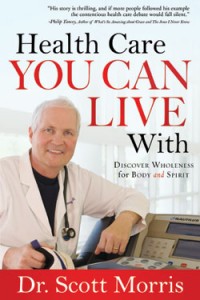
 Here are my thoughts from my reading of Health Care You Can Live With by Dr. Scott Morris, founder of the Church Health Center in Memphis, Tennessee. The excerpts below are directly from Chapters 23 and 24.
Discover the Balance
When new patients come to our facility without an urgent illness we don’t start with the doctor; we start with a health coach. The health coach identifies areas where the patient seems to be doing well, along with the areas of everyday life that may be negatively affecting health. After this 30 minute session, the nurse enters the process in the way you would expect in most clinics, and then the patients see the doctor.
Life is a complicated web, interconnected at every turn. The various parts of our lives bump up against each other. Virtues are marching orders for how to live. They are overarching ideals that we must translate into specific actions – how to accomplish change. Our Model for Healthy Living is a tool for individuals to use to take charge of their own health care, and it reflects that true wellness is not just about our bodies, but about body-and-spirit. We illustrate visually how seven key dimensions of our body-and-spirit experience overlap at the core of our lives.
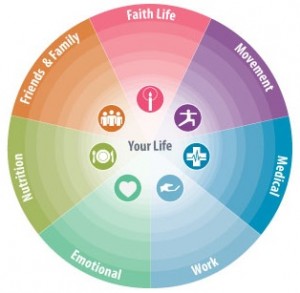 Nutrition, Friends and Family, Emotional Life, Work, Movement, Medical Care, and Faith Life are the key components of the model.
It’s all about balance. Not one of the seven elements in the Model for Healthy Living is more important than any of the others. If you ignore one, the whole mobile goes out of balance. If you overemphasize one, the whole model goes out of balance. If you touch one part of a mobile, the whole mobile moves, respondents, and readjusts. These seven elements are present in every person living in a healthy way, body-and-spirit. The Model for Healthy Living gives you some framework for change. Specific goals in the seven areas will get you where you want to go.
Make Goals You Can Keep
The starting point (for taking charge of your health) is understanding that you are a body-and-spirit being created and loved by God. When you grasp this, you glimpse the level of health – wholeness, well-being, connection to God and others – that God means for you to experience. As you take the turn toward wholeness, the virtues of Colossians 3 surround you: compassion, kindness, humility, gentleness, patience, forgiveness and love. You receive these graces from God and more and more learn to give them to others and yourself. This is the context where change can succeed.
“Therefore, as God’s chosen people, holy and dearly loved, clothe yourselves with compassion, kindness, humility, gentleness and patience. Bear with each other and forgive one another if any of you has a grievance against someone. Forgive as the Lord forgave you. And over all these virtues put on love, which binds them all together in perfect unity.” Colossians 3:12-14
To begin with, meet yourself where you are. Then you can begin to make changes that will take you where you want to go. Don’t expect drastic changes overnight, but recognize the value of any forward movement, no matter how small it seems at first. You get where you want to go one step at a time. Changed behaviors will take you where you want to go.
Behavior changes when you name the new habit. Name the specific habit you want to form, and picture yourself doing it, one step at a time. Behavior changes when you see progress. Progress is something you can measure. Rather than saying, “Get some exercise,” say, “I will walk with the dog around the park and back every Monday, Wednesday, and Friday afternoon.”
A strong goal statement will have a verb at the core. It will map out what you will do and how often or by when you will do it. Example – “In the next two weeks, I will experiment with six different pieces of exercise equipment for 30 minutes each, and rank them in order of how much I enjoy them.” Break down big goals into specific action steps you can take within a definite period of time. Each action, when accomplished, leads to the next action statement that takes you closer to where you want to be.
Set SMART Goals
S = specific, simple, signification
M = measurable
A = actionable, achievable, attainable
R = realistic, relevant
T = timely, time bound
My Comments:
We are certainly a multifaceted, multi-part being. What happens to a part of us or to an aspect of our lives will invariably affect another aspect of us. To be whole – to be healthy – it’s important that we address each component in Morris’ Model for Healthy Living.
I’ve used the SMART goals concept for many, many years in working with people in my wellness programs and in my Christian wellness coaching. I believe it to be a very helpful acronym when a person sets any goal for their lives, especially health behavior-related goals. So many people set a goal for themselves without really preparing how to achieve the goal. Applying the SMART acronym can help in addressing aspects of the goal that are important to be successful.
“Where there is no vision, people perish…” Proverbs 29:18a
In that we are in the second week in January, a time in which many people set goals for themselves, I hope that the above information on SMART goals is be helpful.
More Posts About This Book:
Read all the posts about this book in the category of Health Care & Wholeness
Subscribe to the RSS feed for just this category.